JBRA Assist. Reprod. 2012;16(5):278-281
ARTIGO ORIGINAL
doi: 10.5935/1518-0557.2012.16.5.04
The fate of stored human embryos 5 years after approval of embryo stem cell research in Brazil
1ORIGEN - Centro de Medicina Reprodutiva, Belo Horizonte, Brazil
2Universidade Federal de Minas Gerais, Belo Horizonte, Brazil
ABSTRACT
After human embryonic stem cells were successfully obtained from frozen embryos, donation for research became a new alternative for surplus embryos. The aim of this study was to analyze the impact of Brazil’s Biosecurity Law on the availability of frozen embryos donated for embryonic stem cell research, through the observation of the number of embryos donated for that purpose by patients of a private clinic and by obtaining data from the national Health Surveillance Agency’s online registers. A total of 43 couples donated 245 embryos for research between 2005 and 2010. Couples kept their frozen embryos for 3.35 years before donating them to research and the mean age of the women was 36.54 when donation took place. A total of 37 couples (86%) that donated embryos for research achieved pregnancy during IVF fresh cycle. In 2008 in Brazil, 573 surplus frozen embryos, from 50 IVF clinics, were donated for human embryonic stem cell research and in 2009, 455 from 31 IVF clinics were donated. A reduction in embryo donation, therefore, was observed. We believe it is necessary to release information and promote public discussion to clarify the potential of embryonic stem cell research, as a strategy to increase the number of embryo donations for research.
Key words. Embryo Donation, Research, IVF, Stem Cell
INTRODUCTION
Since the report of the first live birth from successful cryopreservation of human embryos (Trounson & Mohr, 1983), many advances related to cryostorage have been published (Vajta & Kuwayama, 2006; AbdelHafez et al., 2010). More recently, the use of vitrification has increased embryo survival rates and thus resulted in higher pregnancy rates (Kuwayama et al., 2005; AbdelHafez et al., 2010). Besides the higher pregnancy rates associated with this technique, cryopreservation is associated with a lower risk of multiple pregnancy and of developing hyperstimulation ovarian syndrome. Additionally, it reduces the costs of fertility treatment (Kuwayama et al., 2005; Mohler-Kuo et al., 2009; Knopman et al., 2010). Currently, cryopreservation is being used routinely in most human assisted reproduction programs to store surplus embryos generated by in vitro fertilization (IVF). The great production of frozen human eggs and embryos generated by IVF led countries around the world to establish legal basis for the number of eggs that can be inseminated and embryos that can be cryopreserved, in an attempt to avoid the ethical issues associated with abandoned frozen embryos (Lornage et al., 1995). In some countries (United States of America, Brazil, Spain), there are no regulations that dictate how long a frozen embryo can be stored whereas in others a limit of time for storage has been established. These are Denmark (2 years), the United Kingdom, Switzerland, Belgium, Australia, and Sweden (5 years) (Bangsboll et al., 2004; Hammarberg & Tinney, 2006; Hug, 2008; Luna et al., 2009; Mohler-Kuo et al., 2009). Abandoned embryos may be discarded, donated to another infertile couple, or donated for research, depending on the legal possibilities in each country and the wish of the embryo’s donor.
Since 1998, when the first lineage of human embryonic stem cells (hESC) was produced and maintained, many hESCs were successfully obtained from frozen embryos. Work with hESCs holds great promise in several fields of medicine, especially in regenerative medicine (Odorico et al., 2001; McMahon et al., 2003; Allegrucci & Young, 2007; Fenno et al., 2008; Ethics Committee of the American Society for Reproductive Medicine, 2009). Therefore surplus embryos may be donated for hESC research.
Research using hESCs in Brazil has been regulated by the Biosecurity Law (L. 11.105, 24 March 2005). However, only after additional debates in the Brazilian Supreme Court in 2008 could studies in fact be initiated (Squizato, 2008).
The Biosecurity Law allowed the use of human embryos in hESC research that were spontaneously donated by their owners and that had been frozen for more than 3 years after the enactment of the law or those frozen until that date, and for which the cryopreservation period had been at least 3 years. In addition, the law allowed the use of non-viable embryos presenting genetic alterations detected by preimplantation genetic diagnosis (PGD), embryos arrested for more than 24 hours after IVF, or embryos presenting severe morphological alterations that could affect their development. Parents’ consent is also required under the legislation. The aim of this study was to analyze the impact of the Biosecurity Law on the availability of frozen embryos donated for hESC research in Brazil. We evaluated the number of embryos donated for this specific purpose by patients of a private clinic, also using data from the national Health Surveillance Agency’s (ANVISA) online registers, and investigated the characteristics associated with those who chose this fate for their surplus frozen embryos.
A better understanding of how this process is taking place in the country and what factors are associated with embryo donation for hESC research is crucial in order to develop strategies that provide couples with the information they need to make informed decisions about the fate of their frozen embryos.
MATERIAL AND METHODS
Data collection (number of frozen embryos, age of patients, number of donated embryos, year of donation) was performed using our local database at Centro de Medicina Reprodutiva - ORIGEn in Belo Horizonte, Minas Gerais and the Brazilian national Health Surveillance Agency’s (ANVISA) registers (SIS EMBRIO) available online (http://portal.anvi-sa.gov.br). The data of SIS EMBRIO go back to 2008 when 50 IVF clinics in the country reported the total number of frozen and donated embryos. In 2009, only 31 IVF clinics reported their number of frozen embryos. The study was approved by the research ethics committee of the Universidade Federal de Minas Gerais (COEP/UFMG).
Data were collected for a period corresponding to January 2005 to September 2010 (almost six years). We evaluated the donation of frozen embryos to hESC research that was carried out in our private clinic and donation done in other clinics in Brazil. We also evaluated the donation of embryos according to pregnancy rate and according to the stage of the embryos at the time of donation.
RESULTS
During the studied period, we observed that a total of 2440 fresh cycles were performed, with 682 (28%) frozen cycles that generated 4400 frozen embryos. A total of 1521 embryos were stored in 2006, and 712 embryos from 104 cycles were frozen within that year.
Table 1 presents the number of frozen, thawed, donated, and total cryostored embryos during the 2005-2010 period. Figure 1 shows the number of embryos donated for HESC research per year, in relation to the number of cryopreserved embryos during the same period. A total of 43 couples (6%) donated 245 embryos for research within the last 5 years, 139 (57%) of which were frozen in day 2 and 3 stage, 86 (35%) in pronuclei stage, and 20 (8%) in blastocyst stage. During IVF treatments, the ages of the women who donated their embryos ranged from 26 to 50 years (mean 33.16). Couples kept their frozen embryos for an average of 3.35 years and the mean age of the women was 36.54 when donation was made. A total of 37 couples (86%) that donated their embryos for research achieved pregnancy during IVF fresh cycle.
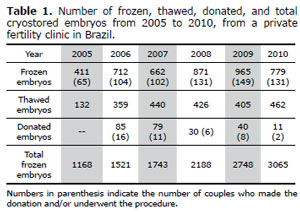
Table 1. number of frozen, thawed, donated, and total cryostored embryos from 2005 to 2010, from a private fertility clinic in Brazil.
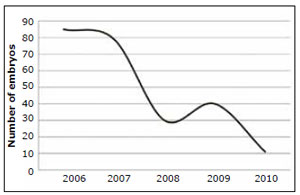
Figure 1. number of embryos donated for hESC per year from a private fertility clinic in Brazil.
The SIS EMBRIO data go back to 2008 when 47,570 cryopreserved embryos were registered and 643 (12%) were donated for hESC research. In 2009 there were 8,058 frozen embryos in Brazil and 455 (6%) were donated for hESC research.
DISCUSSION
Stem cells are the great promise for the future of regenerative medicine. Embryonic stem cells are able to differentiate into tissues of three germ layers (endoderm, mesoderm, and ectoderm) and also show great potential to be used for developing new treatment modalities for a wide range of serious diseases such as Parkinson’s, diabetes, Alzheimer’s, spinal injuries, and several heart conditions (Thomson et al., 1998; Klimanskaya et al., 2008; Trounson, 2009; Vazin & Freed, 2010). The first embryonic stem cell trial in human patients is currently being conducted in USA to treat spinal injuries (Alper, 2009). Another group in the USA has been authorized by the Food and Drug Administration to perform embryonic stem cell transplantation to treat retinal diseases (Lu et al., 2009).
Some studies have shown that stem cells can be obtained without destroying the embryo by doing a biopsy of the embryo in which a single cell is removed and then is cultivated until it reaches the blastocyst stage (Geber et al., 1995; Boada et al., 1998; Klimanskaya et al., 2006). Other studies reveal that somatic adult cells can be induced to a pluripotent stage through the integration of some genes (Takahashi et al., 2007; Yu et al., 2007; Park et al., 2008). However these studies cannot replace hESC. Embryonic stem cells and induced pluripotent stem cell studies are complementary because they improve our understanding on how to maintain pluripotency in these cells (Park et al., 2008).
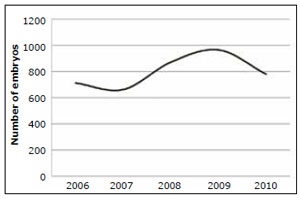
Figure 2. number of cryopreserved embryos per year from a private fertility clinic in Brazil.
Our results show that 86% of the couples that donated their embryos for hESC research achieved pregnancy after the IVF fresh cycle. These results are similar to those observed by McMahon et al. (2003) who described that couples tend to donate their remaining frozen embryos after achieving a successful IVF. Bangsboll et al. (2004) showed that having children due to IVF was a favorable factor to donate embryos for stem cell research in Denmark. Mohler-Kuo et al. (2009) observed that once pregnancy is achieved, couples usually abandon their surplus embryos.
In our study, the mean age of the women when they donated their embryos was 36.5 years. These results are in agreement with others (Hoffman et al., 2003) in which women ≥38 years were less likely to make an embryo donation than were younger couples. Bangsboll et al. (2004) described that being a woman <35 years old was a favorable factor for donation of embryos for stem cell research. Hammarberg & Tinney (2006), however, did not find any association between parents’ age and embryo donation.
The storage mean time before couples donated their embryos was 3.4 years. McMahon et al. (2003) observed that the willingness to donate frozen embryos is greater in couples who have had them stored for a period of time, which is consistent with the findings of Luna et al. (2009) who reported that the couples’ choice for donation was higher after 5 years of storage. In these studies, couples were asked about their intention to donate their stored embryos, while in our study the donation was done spontaneously.
From 47,570 frozen embryos in Brazil, 643 embryos (1.4%) were donated to hESC research in 2008 (50 IVF clinics). In 2009, 455 embryos were donated, however the total number of cryopreserved embryos is unknown (31 IVF clinics). The results observed in Brazil are different from those described in United States and Canada in 2003 where 2-3% of the embryos were available for hESC research. In Australia and Europe the willingness of couples to donate their embryos (40% to 90%) was higher when compared to the United States and Canada. These differences may be due to more restrictive policies in human embryonic stem cell research in these countries. In Canada, a survey applied to investigate the willingness of couples to donate their frozen embryos for research found a rate of 54% (Hoffman et al., 2003; Choudary et al., 2004; Hug, 2008).
We observed a reduction in the rate of embryos donated for research over the years despite the continuously increasing number of frozen embryos throughout the same period. Several reasons may impact the decision of embryo donation for research, including the approach applied and the moment of the donation request, the individual’s age, status of IVF treatment (whether or not successful), cyostorage period, ethnical and cultural values, religion, political and social environment, cryopreservation fees, and information availability about hESC research and advances (Bangsboll et al., 2004; Choudary et al., 2004; Cortes et al., 2007; Hug, 2008; Luna et al., 2009).
In Sweden, 92% of 331 couples preferred to donate their surplus embryos to stem cell research than to discard them. This might be related to the high level of information provided on HESC research and to an altruistic nature of Swedish couples (Bjuresten & Hovatta, 2003). Lanzendorf et al. (2010) observed that patients in the United States (59% of 149 couples) who wanted to discontinue the cryostorage of their embryos were more likely to donate them for research than simply discard them. Bangsboll et al. (2004) reported that in Denmark 49% of 101 couples donated their frozen embryos to hESC research, when they were asked about the fate of their embryos. This study, however, was performed with couples for whom the period of embryo storage had exceeded the limits allowed by Denmark’s legislation. In a Spanish study, 97 couples were interviewed in two different public IVF units about the fate of their embryos that were being kept frozen for periods longer than 3 years. Forty-six couples had donated 192 embryos (45%) from a total of 428 frozen embryos. It is important to clarify that the results were similar in both IVF units, located in cities with different economic and social profiles (Cortes et al., 2007).
When the law was approved in Brazil, a lot of information was released by the media concerning the hESC research. In 2005, approximately 80 embryonic stem cell-related articles were published in four mainstream Brazilian newspapers, in print and online. In 2006, these sources published 60 news articles. In 2007, 134 news articles were published. In 2008, when the law was finally considered to be in accordance with the country’s constitution, 396 news articles were published. Since then, the number of articles published about the subject has diminished: 129 in 2009 and only 68 in 2010. This lack of news on the subject may explain the observed reduction in embryo donation for research.
We believe it is necessary to release information and to promote public debate and discussion to clarify the potential of embryonic stem cell research. Also, couples that have surplus frozen embryos should be contacted by IVF clinics so their apprehensions can be understood and the stem cell research can be elucidated and the procedures demystified. These actions may help increase the number of embryos donated for research in Brazil.
Squizato R. Brazilian court decision eases scientists’ stem cell worries. nat Med. 2008; 14:699.
Trounson A. New perspectives in human stem cell therapeutic research. BMC Med. 2009; 7:29.
Vajta G, Kuwayama M. Improving cryopreservation systems. Theriogenology. 2006; 65:236-244.